
The Abulafia (‘El Transito’) Synagogue in Toledo, Spain and the family’s heraldic heritage
Today we will explore a famous monument to the achievements of the Jewish Sephardic community and what it can tell us about the heraldic heritage of its founder, his family and by extension, of the Jews of Spain.
The Abulafia Synagogue in Toledo, Spain, known as ‘El Transito’, is a world famous architectural structure. It was built as the ‘private’ synagogue of Rabbi Samuel Ha-Levi Abulafia and his family, which only means he personally had received the king’s permission to build it, but clearly (by its size) it was for use by the local Jewish community. After the expulsion decree of 1492, it was converted to a church and handed over to the Order of Calatrava. Arms appear on a refurbished door and christian altar made by these later patrons of the structure, which may be of interest themselves. But this article will focus on remnants of the original heraldic depictions on the synagogue’s decorative stucco.
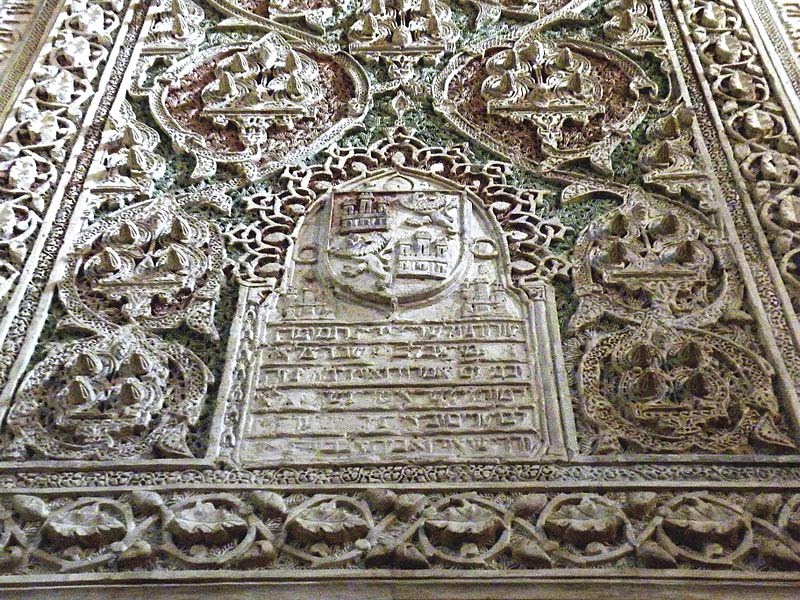
The Synagogue interior is covered with stucco (plaster) all over the eastern wall and on the uppermost portions of all sides, where the women’s gallery used to be. On the eastern wall are three rectangular sections of decorated stucco, the central one housing the ‘Holy Ark’ which would contain the Torah scrolls. Beside it are two further decorated sections. The lower part of these side ‘panels’ include inscriptions of dedication which are each topped by an armorial shield depicting the royal arms of Castille & Leon. The arms have at their ‘feet’ (to the side of their base) two depictions of a ‘badge’ – that of a triple turreted castle with two (or three) fleur de lis atop the side turrets (and main turret). These ‘side badges’ don’t seem to have ever been scrutinized by scholarly academic writings or research, taken to be simply decorative, or rather redundant. But are these ‘Lilied Castles’ so innocent?
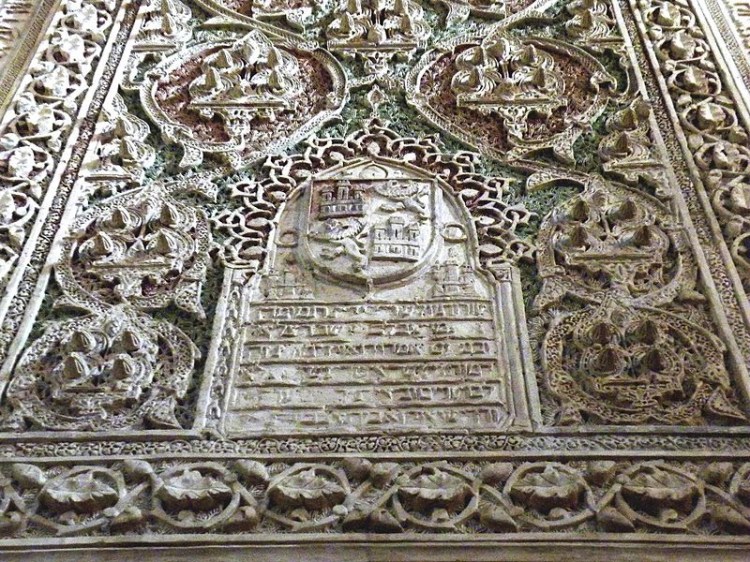
Credit: Wiki Commons, Roylindman, under Creative Commons 3.0.
I had first noticed these random ‘lilied castles’ some years ago (in one or two separate images from books etc.) and wondered about their meaning. I will claim here that these in fact represent the arms (or Badge) of the Synagogue founder Samuel Abulafia. My first presumed proof of this, lay in the fact of my already existing familiarity with one of the most ‘famous’ medieval Jewish seals known to still be in existence. The seal is located in the British Museum, and was made for a ‘Todros ben Shmuel HaLevi N’E’ (‘RIP’) Al-Levi’, as engraved in the Hebrew inscription around the seal. The Halevi family is one and the same as Abulafia, presumably kept out of the inscription, simply as it was a non-Hebrew term.
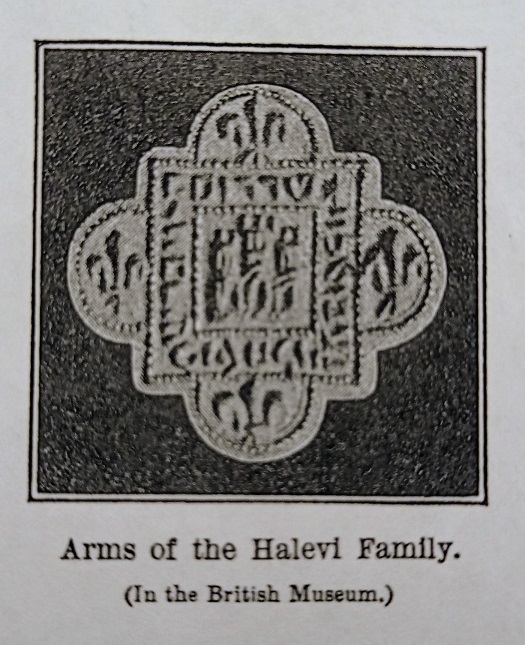
The seal’s general shape is that of a quatrefoil, visually shaped by a square and the outline of smaller semi-circles on every side. This symmetrical shape was a popular theme in medieval architecture and art, itself perhaps representing a lily viewed from above. The writing mentioned follows the edges of the square with fleur de lis appearing on each rounded counter-facet, totaling in four and in the center of the entire design, a Castle. So a Castle with four Fleur de lis, on a seal that would safely appear to belong to a family member (if not the actual son) of the man that constructed the Synagogue that has beside the royal arms of their patron, the King, a Castle with two or three Fleur de lis. Seems hard to believe this is coincidental. One could argue that as the seal includes one more fleur de lis, that perhaps this is a kind of evidence the owner was a generation later than R’ Samuel the treasurer, who seems to have used three fleur de lis only (perhaps these represented generations in positions of power or service to the kings of Castille?). A further step would be to specify that the depiction within a shield (as brought in the next paragraph) is always with only two lilies, perhaps suggesting the arms were from the generation of Samuel the treasurer’s father?
But little did I know there was much clearer proof of this connection, in the same synagogue itself. You see, it’s hard to conclusively prove the connection between the seal’s owner to Rabbi Samuel the treasurer. The names Todros and Samuel are both found in the family through several generations, so the exact relation seems to remain uncertain. Meanwhile, from images available online (WikiCommons etc.), one can see that on the synagogue’s western Wall, and on the northern and southern walls as well – more shields appear – some with the royal arms again, others – apparently six, have a triple turreted Castle with two Fleur de lis above the two side turrets. From the images available on WikiCommons, it would also appear that color traces are still found, which seem to show a blue field (the shield’s background). Moreover, the corners of the two side sections (or side panels) on the eastern wall mentioned earlier feature further repetitions of the ‘lilied castle’ badge, described above. In total, there are 12 depictions of this badge, on the eastern wall alone.
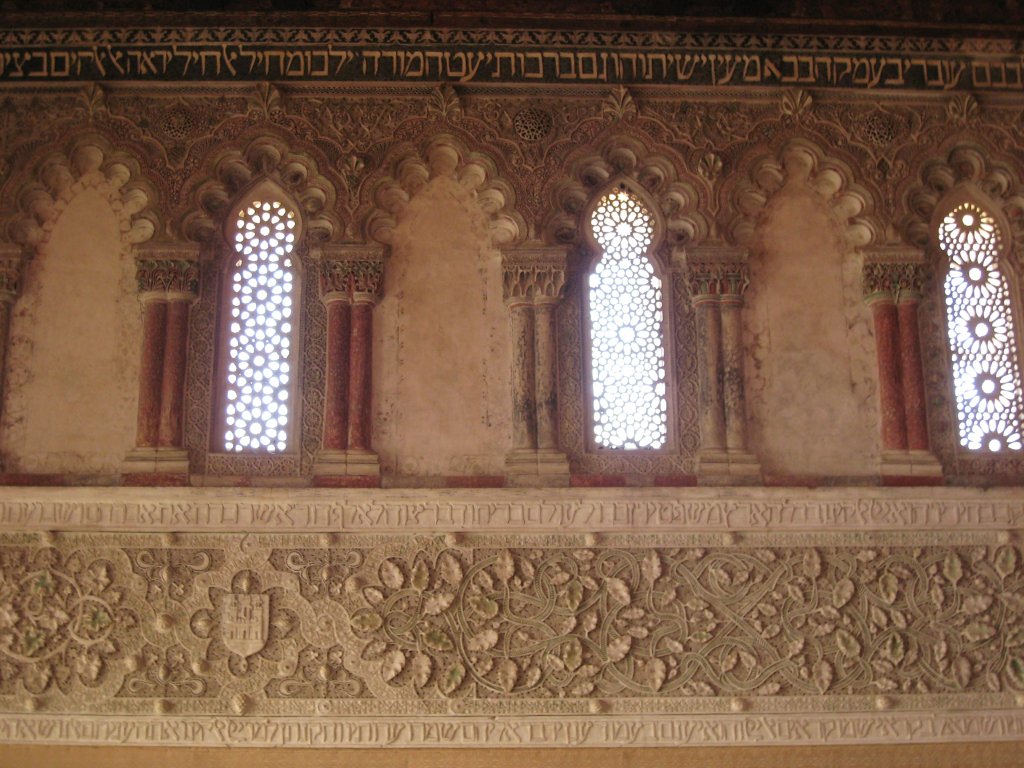

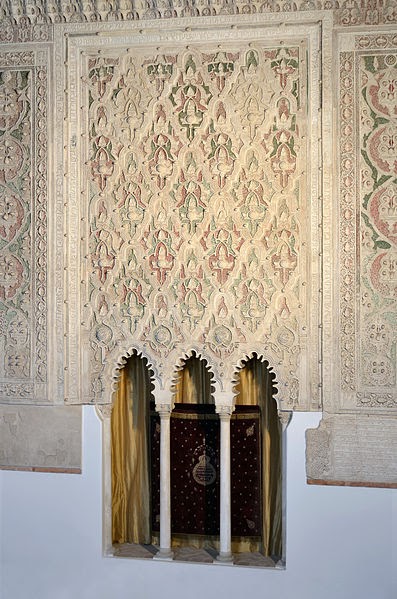
(Credit: Wiki Commons, Selbymay, under Creative Commons 3.0).
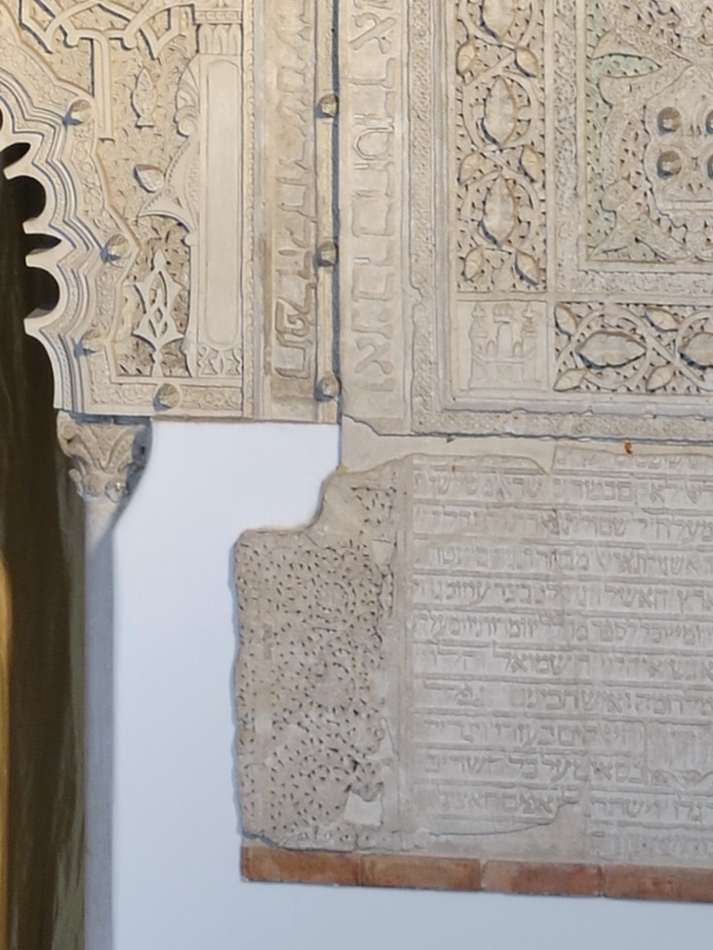
From all this online evidence, a much clearer picture emerges. The Abulafia family seems to have used the following arms – Azure a triple turreted Castle each of the side turrets topped by a Fleur de lis. The colors of the elements (or charges) in the arms are not certain, but logically, the castle was probably gold (Or), the Fleur de lis possibly either of the two metals (Or, Argent). In total, six such armorial shields seem to appear around the synagogue walls. The devices engraved on the seal, as well as the devices in the Synagogue – those beside the Royal arms on the eastern dedication inscriptions & panel corners, and four others in the western wall above two windows, where they are found within an quatrefoil similar to the seal, should be viewed as Badges, either in a pre-heraldic sense or indeed as an heraldic accompaniment to the arms.

Thanks to the images on Wikipedia or WikiCommons, any mystery around the possible relationship between the Seal of Todros and the images in the Synagogue of Samuel Abulafia would seem clearly lifted. Similar images are viewable on Google, via Google maps, but these are possibly copyright protected, hence not shown here. The nature of the images themselves (those on the eastern side) are further clarified by closer inspection of images from the other sides.
My conclusions are that the Abulafia family seems to have used an heraldic device or badge as well as more proper use of arms on a shield by the time of don Samuel Abulafia (1320-1360), if not earlier. But more generally, we can conclude that clear images of whatever monuments are left of the Jewish existence across Europe, will help greatly to further research about the cultural heritage of these communities and among other aspects, their heraldic practices. This naturally hinges upon making such images readily available online. Further requirements are for students of history, art history, Jewish history etc., to be made aware of the existence of heraldry among European Jews, and be encouraged to research it or include these aspects in whatever research they do on the above subjects, when appropriate.
Sources & Links:
- Jewish Encyclopedia: Abulafia ; Abulafia, Avraham (and others)
- Encyclopedia.com: Abulafia, Samuel ben Meir Ha-Levi
- Wikipedia: Abulafia (surname); Synagogue of El Transito; Samuel HaLevi
- Wiki Commons: El Transito
- British Museum: Seal of Todros ben Samuel
- Daniel M. Friedenberg, Medieval Jewish Seals from Europe, Wayne State University Press, Detroit, IL, USA, 1987, pp. 124-126. (Available online through Project Muse, JHU, here).
 THE HEBREW HERALD