
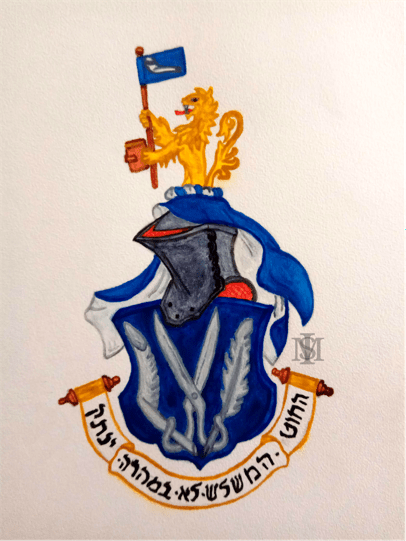
In this post we will present the translation we offer to a number of basic terms in the field of heraldry. These are really basic terms to adapt the Hebrew-speaking reader to the level of recognition and description of Europeans in this field. We will not go into the more artistic terms, so as not to extend beyond the need. Hopefully the heraldic design terms will get their own post or posts later.
- Family Insignia (סמלי משפחה – סמלי כלים)
- Armorial Bearings – Armorial Achievements (נשיאת כלים – הישגי כלים)
- Heraldry – Herald (הראות – רואה)
- Shield (שלט)
- Crest (טוטף/עיטור קסדה)
- Sign/Insignia (אות/סימן)
- Symbol (סמל)
- Badge (תג)
Family Insignia/Armorial Insignia
(סמלי משפחה – סמלי כלים)
This term is used on the site instead of the next term on the glossary, ‘Armorial Bearings’ (which is perhaps more accurate), as it simplifies the concept a bit for any Hebrew speakers who happen to be unfamiliar with heraldry. Also, heraldry in its use by Jews in the various exiles in Europe, usually took after ‘mediterranian’ forms and styles, that is the Iberian and/or Italian traditions of heraldry or something very similar to it. In Italian the term ‘Stemma di famiglia’ is frequently used for ‘coats of arms’ as they are better known in English, so the translation seems to work well in Hebrew. This term would therefore mean the symbols used by a family (although in general usage can relate to its use by entirely different bodies – such as businesses), but especially the shield and its immediate accoutrements.
Armorial in this respect refers to the tools or instruments of war, which would be some of the most prized possessions of a family’s property and definitely would carry their symbols on them. Hence, Armorial insignia is a synonym for Family Insignia. In Hebrew, instead of focusing on the military or warish aspect of ‘armor’, the term for ‘tools of..’, Kelim (כלים) works better, especially in a modern Hebrew context. top of page
Armorial Bearings – Armorial Achievement
(נשיאת כלים – הישגי כלים)
A term referring to the entirety of the arms and its accoutrements carried by a family, person etc., as mentioned in the above entry ‘Family Insignia’. It is not used in the main pages of this site as it translates poorly into Hebrew, that is to say – in a foreign sounding way.
Armorial Achievement is a further development to ‘Bearings’ and seems to refer to a person’s arms after his departure from this world, hence representing the sum of his achievements in this world. This seems apparent due to the term’s development from the earlier ‘Armorial Hatchment’ – a wooden painted or carved representation of arms placed in churches. It would include any medals and decorations he was awarded, pieces representing knighthood, like spurs, hats of office etc. Similarly, Jewish tombstones often would include some image representing the deceased’s main achievement in this life, a charity box for the generous, six books seen from the spine – for the diligent student of the six tractates of Mishnah etc. top of page
Heraldry – Herald (הראות – רואה)
The generally accepted term for the whole of the field(s) dealing with ‘coats of arms’ (called specifically Armory by some), pedigrees & genealogy (until mid 20th cen.), flags (likewise till mid 20th cen.), orders & decorations, state ceremonies, even diplomacy – mainly in the medieval period. The term of course comes from the position holder- a Herald. The English term is said to originate in an old german term ‘Herawald’ but either way, the french uses ‘Heraut’. The translation to Hebrew works better with this french term serving as a direct parallel. Transliterated to hebrew, Heraut (הראות) literally means to ‘be seen’. This in extension perhaps relates to a commandment the Jewish people have to be seen at the chosen place of the creator (the sanctuary in Jerusalem) three times a year. This then could understand the commandment in a renewed way, that to be seen, the emblems or flags of the families present should be shown as well.
Herald (רואה) is therefore taken in the extension here, or rather the root in hebrew of ‘Heraut’ (הראות), ‘Roeh’ (רואה) a term likewise ancient in hebrew, one of the terms for a prophet, a seer. Indeed, the heralds are to see arms and recognize them and heraldry is about viewing arms of others and recognizing them, and so the translations seem to fit rather nicely. top of page
Shield (שלט)
Another translation based on the sound of the term in English that surprisingly seems to fit snugly into a term known well in hebrew, albeit not in entirely the same meaning in the modern hebrew usage. The term is used nowadays for signs, billboards and so on, but I think it must have originally meant something very close to what Shield means in english. This refers to the war shield that comprises the main element of ‘armorial bearings’. This reminds us that even if we live in more peaceful societies than in the past, life, however it is lived, represents a struggle between good and bad decisions, and the arms are there to help keep us protected by our values, remind us what those are and guide us visually to victory. top of page
Crest (טוטף/עיטור קסדה)
An additional emblem placed above the war helmet that is itself usually placed in depictions above the Shield. Jewish heraldry in Europe is frequently found without a Crest, in fitting with the Iberian and Italian traditions that we mentioned it shared much with. It’s absence then in no way represents some ‘lack’ in status or ‘officialness’ to the armorial insignia. In German and Netherlandish usage, the crest is referred to as the ‘Oberwappen’-the over helm or ‘Helm teken’-the helm decoration. This was used by me as a possible translation, (עיטור קסדה) literally helm decoration. Another option is the somewhat vague biblical phrase Totaf (טוטף) found in the plural, and considered traditionally as the source for Tefillin (phylacteries) termed in the bible Totafot. This is of course an object worn on the forehead and is specifically referred to as a symbol or sign – Ot (אות). So to think of a symbol worn over the head and headgear as a Totaf (טוטף) seems logical indeed. top of page
Sign/Insignia (אות)
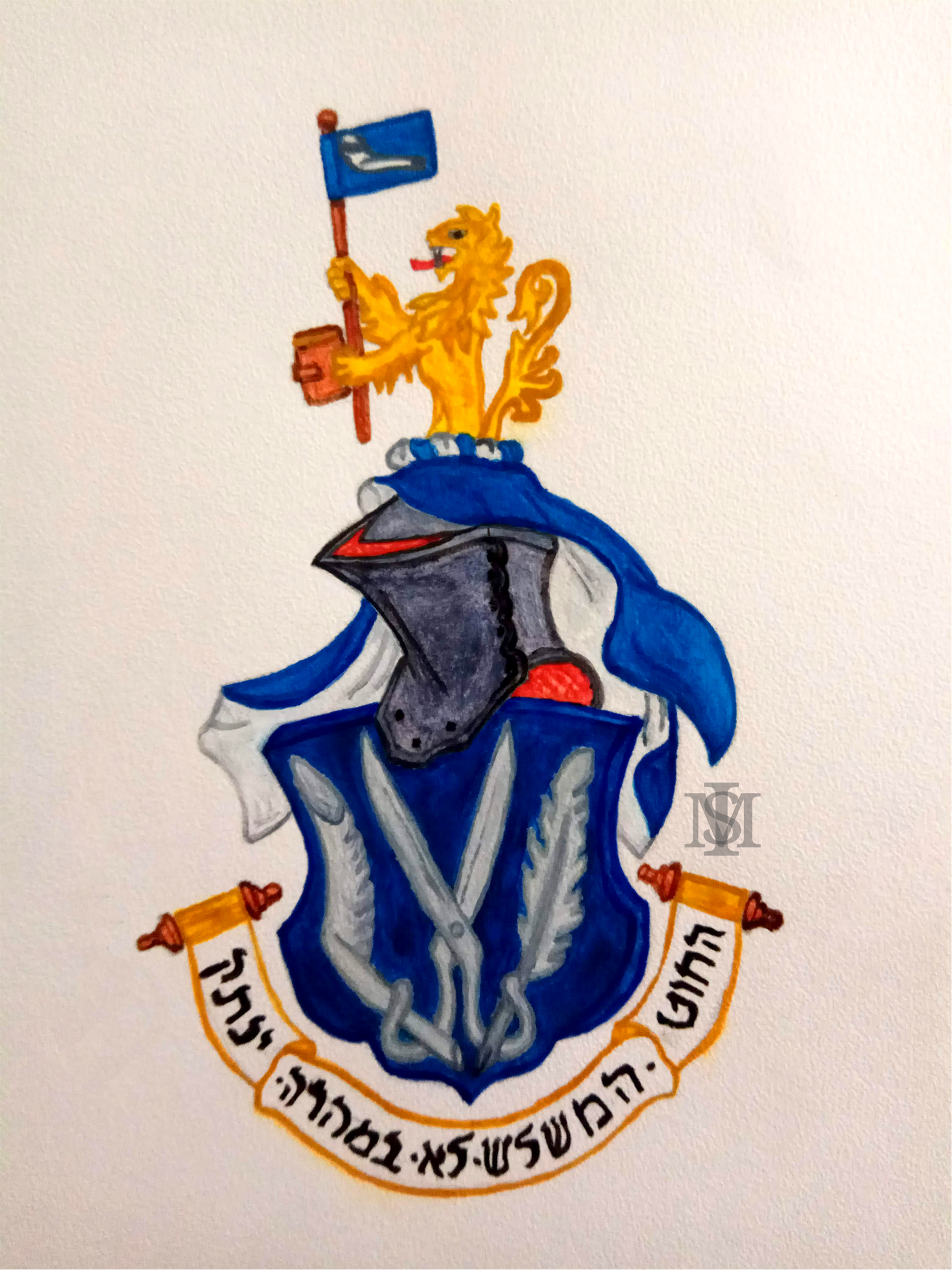
An entirely overused term in Hebrew, Ot is used in the book of Numbers for the famous and often quoted “..with the ensign of their father’s house..(Numbers 2,2)”. Therefore, we could assume it would be used in Heraldic phraseology. Indeed it could be used as translation for Badge, as a pre-heraldic emblem, or as an Heraldic badge. But to use it in any further way, in connection with the armorial bearings themselves, would serve only to confuse and obfuscate the matter. It is already in use in modern Hebrew for everything from heraldic-like emblems, badges, medals, pins, ribbon bars etc. top of page
Symbol (סמל)
A sort of substitute for the above entry (Ot), the origin of Semel is less ancient, but no less overused in modern Hebrew. Emblems of any sort – including logos, pins, badges and so on, are all brought under the umbrella of Semel these days. This confusion of terms is but one reason for the need to (re)introduce Heraldry to the Jewish consciousness and Israeli national culture. The term does become useful when combined with ‘family’ hence the use of ‘Family Insignia’ (Semel [Simley in plural] Mishpacha) as brought at the start of this post. top of page
Badge (תג)
As we’ve mentioned earlier in the post, badge is a generic name for emblems that are not necessarily heraldic. Therefore, it is used to describe pre-heraldic emblems and heraldic accompanying ‘sub-symbols’. These are usually only needed these days by institutions, corporations and government bodies etc., that have ‘retainers’ (employees) and much property similar to a medieval lord. On the other hand, Jewish arms historically probably often started as badges on seals and property, so there may be a reason for extensive use of these today too in Jewish heraldry.
The hebrew term for Badge could in theory be any of the previous two terms translated (אות/סמל), but ‘Tag’ (תג) seems more appropriate, as it shares a similar sound. This has been a repeated reason for us in choosing a translation, based on the religiously held theory that hebrew is directly descended from the original language (or is the original) and therefore all languages should have residue terms, similar terms or derivatives. In our case, Tag/Thag/D’ag – depending on how the pronunciation is, seems with a move of the ‘a’ and dropping the ‘B’, similar to (b)adge. This also is similar to the turkic ‘Tamga/Tagma’, which means Sign or Badge. top of page
 THE HEBREW HERALD